| ABOVE: Google Analytics data (since the start of GA4) showing the decline in non-bot (real visitor) traffic to stormhighway.com's popular lightning science pages from 2023 to 2026. These pages typically receive their highest traffic during the spring and summer storm seasons. The big drop in 2023 happened when Google implemented another big algorithm update to show mostly government and mainstream media sources for most search queries under the guise of 'fighting misinformation'. Since then, the further drops are from the transition to AI summaries.
It is this de-facto communism of intellectual property that was the final blow for my operation: a seizing of all of the IP in existence not by the government, but by Big Tech corporations. And unlike a government implementation of communism, the oligarchs of this regime don't do anything to provide for the basic needs of the workers they've taken careers from.
I'd previously had to curtail my storm chasing operation, mostly due to the piracy and infringement of my pictures and Youtube videos being copied to social media (I've written about the problem extensively). I've been able to keep my operation going only thanks to occasional copyright infringement case settlements via my agents at Viral DRM. But the AI takeover of my life's work is too much to bear on top of everything else.
This wasn't how I planned for things to turn out. I'd always wanted to keep this site going indefinitely throughout whatever the winds of change brought to the internet.
There are big and landmark court cases in progress now (one I am a part of) to address both the piracy issues and the AI scraping threats. To be honest, I don't expect much from these. I'm just tired of fighting. The bad guys are winning. Everyone supports them. I'm even called the bad guy for objecting to and fighting against the fruits of my life's work creating great success and paying the bills of Big Tech and pirates, but not for me.
I am not sure where I will go from here. My Youtube channel, photo galleries and my page documenting the infringement problems will remain online for now. I'm putting some effort into organizing my existing and new material into book form, though I'm not sure if that will be viable. That kind of publishing faces the same existential threat from piracy and ingestion into AI systems as my web site did.
The way things are now, every minute of work I do and every dollar of costs I cover will only go to feed the pirates and the Big Tech machine. I'm also having to work full time now in an IT job. I don't have the time I used to have to produce what I did before. And I'm just tired at the end of the day. I have no motivation to produce anything any longer. Even if I did, I don't have the time and the income to support it.
I'll close on a positive note. I'm thankful for everything I've been a part of in what has been an incredible life of adventure. I'm especially grateful for all of the readers and viewers I've had over the past 31 years. It's been a great ride. For those who have supported me during that time, I send my sincerest thank-you.
I'm confident the Lord will guide me in where things go from here. He's always taken care of me, and I am at peace knowing that won't change as this chapter of life concludes.
-Dan
A look back: 31 years on the web
This site was first called The Lightning Page, and kept that name until moving to the wvlightning.com domain in 1998. From 1998 to 2007, the site grew under the West Virginia Lightning name before moving to its current domain, stormhighway.com. The name changes were simply that - the content remained intact through all of the different names. Some of the lightning pages in the library section were originals from 1995 (with some edits and enhancements added over the decades).
I wrote the first pages of this web site back in October of 1995 at the WVIT engineering computer lab in Montgomery, West Virginia. I did most of the hand-coded HTML and content writing on orange-screened, text-only monochrome dummy terminals connected to the school's network and Unix servers. For you non-IT readers, a dummy terminal was basically a keyboard and monitor connected to a central server on a network - IE, there was no CPU tower at each workstation. You would usually find these systems in department stores, auto repair shops and similar settings.
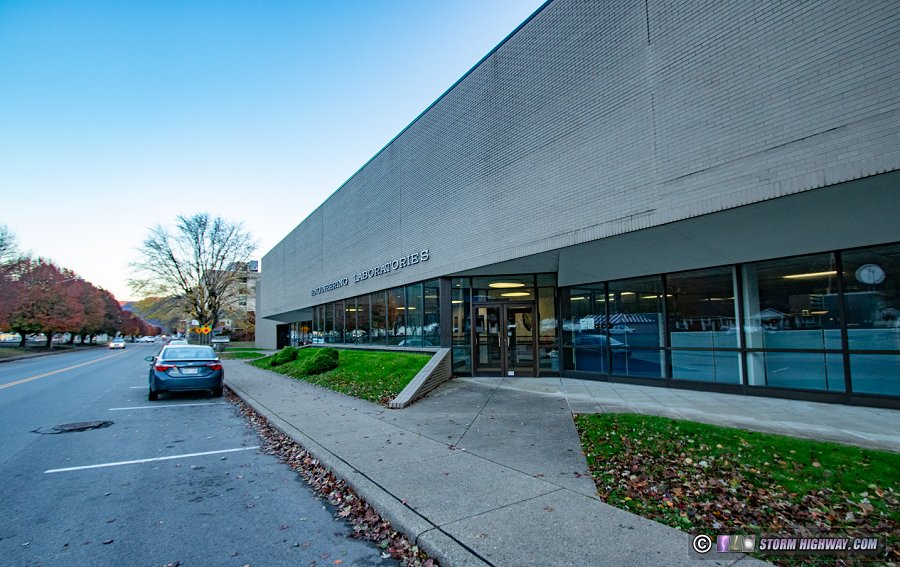
The former WV Tech Engineering Laboratories building in Montgomery, WV.
When I first wrote the site, then called The Lightning Page, I was still using ELM and Pine for email, Gopher was still an active source of information, and the best computers on campus were the 486s with Windows 3.1. For the most part, I wrote my pages blind on the dummy terminals, then later had to go to another (busier) lab to get a quick view on how they looked on normal browsers - in this case, Netscape running on the 486s. I used Lynx (a Unix text-only server-based browser) to preview the site on the monochrome terminals. That wasn't as bad of an inconvenience as it sounds, since the first site had no tables, few images and no real layout to speak of, just text and inline images.
In 1995, I did not own a computer, and would not until the spring of 1997. Until that time, the development of this site took place entirely in my spare time at the computer labs at WVIT. The lightning myths and lightning faq pages are two of the biggest original sections from the first version of this site. Despite revisions over the years, the 'meat' of most of that content was typed out on those monochrome terminals at WV Tech 31 years ago.
 After I got my own computer and a dialup account in 1997, updating the web site took place over Telnet at the Unix shell prompt using the Pico text editor. I did everything server-side, except for FTPing image files as needed. I didn't start maintaining a local copy of the site and fully updating via FTP until 1998.
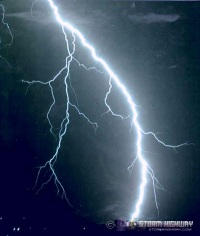
The first photos posted to the site in 1995 were 8x10 prints digitized using a flatbed scanner in a lab in Orndorff Hall (the only scanner on campus that I was aware of), resulting in 256-color GIF images. I had 8 or 10 photos on the site to start with. The first lightning photo I posted to the site was the one pictured at left that I captured on my first storm outing in July of 1993. This image is of the original scan. At that point, I only had three seasons of storm chasing under my belt, yet had a decently successful batch of lightning shots. Most of my early photos were from around Washington and Pittsburgh, Pennsylvania from 1993 to 1995.
The site remained on the WV Tech campus servers until mid-1997 before a brief switch to Cross Lanes-based wvinter.net (who later became Intelos) once I moved to Charleston and started working. Soon after I started my job at CIS in the spring of 1998, I registered the wvlightning.com domain, accordingly changed the name of the site to West Virginia Lightning and moved the site to the CIS server, where it has remained ever since. I registered stormhighway.com in 2006, switched to that new name/identity in 2007 and phased out wvlightning.com, which I still own but have not used since the switch. So there you have it, the 30-year history of this site.
The process of building this site during my time at WV Tech is the sole reason I ended up in the web development career field. I did my first web job on a school Co-op page, then when I moved to Charleston, began a nearly 2-year stint with the newspaper updating their site nightly before landing at CIS.
Old Site Designs
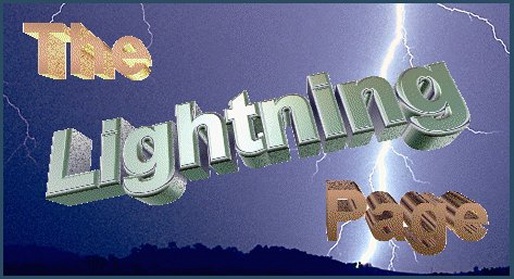
I have kept most of the old files from the previous versions of this site, all but the very first set of designs. The 1995 to 1997 versions unfortunately are lost forever, as they were backed up only on 3.5 inch floppies which are long gone (and probably would not work even if I still had them). archive.org does not have pages from those early versions, but I was able to retrieve two images from the 1996-1997 era, the header image and navbar that I made with a primitive 3D text program:

From 1997 onward, I have a good preservation of the versions of the site, despite a few of the graphics files being lost here and there. The 1999 version shows the benefit of the purchase of the graphics program Paint Shop Pro (prior to that I was using mostly LView Pro). PSP was a great program that I used for design work up until 2007, when I finally moved to Adobe products (Photoshop and Flash). Even so, I still use Paint Shop for certain tasks that I think it does better/faster, such as quick photo resizing, logo overlays and JPEG exporting.
 1997 version  1998 version  1999 version  2000 version  2001 version  2002-2003 version  2004 version  2005 version  2006 version  2007-2009 version  2010-2011 version  2012 version  2013 version  2014-2015 version  2016-2026 version |
Yahoo Directory and Search Engines
In 1995, the Yahoo! Directory - at the time, the most popular search engine/directory on the internet - added a new 'Lightning' subsection to its weather category, and this site was the first and only listing for several months. Thanks to that link, I actually saw some of my highest all-time traffic for a year or so, until the Yahoo page started filling up with other lightning site listings. Thanks to archive.org, a screen capture is preserved:
LINK: Archive.org view of Yahoo! directory on April 26, 1997
I stopped getting traffic from the Yahoo link many years ago, as the directory lost popularity and West Virginia Lightning suffered from being alphabetically last in about 30 or so lightning site listings. The Altavista search engine then became the primary source of my visitors, and for many years this site was always a top result for the lightning keyword. Eventually Google came onto the scene, providing my biggest source of traffic from the mid-2000s onward.
Big Tech and copyright infringement deal a decline ... and finally the end
Starting around 2020, the site experienced another major drop in traffic. This happened because Google began demoting web sites in search results that were not affiliated with government or mainstream media outlets. Searches for storm-related terms and phrases for which this site used to rank highly now return mostly media and government (mostly NOAA/NWS) sites. Google's reasoning for this was to fight disinformation. Likewise, social media sites also instituted similar policies for outgoing links, further reducing the reach of posters that link to this site. The result of this was news articles talking about my photos (such as my Gateway Arch lightning strike captures) would rank on the first page of Google searches, while my original page with that photo not appearing in results at all.
Another major traffic hit happened in 2023 (see the analytics data above) with further promotion of mainstream media and government sites over my originals. To add insult to injury, AI-generated paraphrases of my lightning science articles began outranking my most popular original pages.
Finally, it was social media users and artificial intelligence that dealt the final blow to this site's traffic. Reddit reposts of my tornado images would replace my originals, appearing at the top of Google search results while my site's pages were nowhere to be found. By the middle of 2026, AI overviews and zero-click searches had siphoned off what little traffic was remaining. AI scraper and bot traffic dominated my server log data, with most being single-visitor, zero-engagement time hits. At that point, there was simply nothing to be gained from keeping my site live. Every week would mean a new complete ingestion of my work into yet another AI system.
Version history notes
The site - from day one - had always been hand-coded in static HTML pages, with most composition and edits done in Wordpad or Notepad. I never used database-driven architecture, CMS (content management) systems (like Wordpress or Drupal) nor WYSIWYG software (such as Dreamweaver). Everything was hand-crafted in raw HTML code, and all graphics were original and custom-made (never AI generated). CSS, in my opinion, was not a universally stable-enough platform to begin using until 2012.
- 1995-1996: Single-column layout, inline images. Edited server-side with Pico (UNIX)
- 1997-1998: Frames. Photos edited in Lview Pro.
- 1999: Javascript & tables architecture introduction, 640x480 minimum resolution-optimized. Switch to Paint Shop Pro for graphics/photos
- 2000: SSI architecture introduction (shtml)
- 2001: 800x600 minimum resolution-optimized
- 2006-2009: Incorporation of Flash elements
- 2007: Switch to Adobe Photoshop for graphics/photos
- 2010: 1024x768 minimum resolution-optimized
- 2012: CSS integration, conversion to PHP architecture.
- 2014: Responsive mobile-friendly architecture introduction
|