Power Plant Exhaust-Initiated Thunderstorm Cell
Poca & Cross Lanes, WV - July 18, 2002 - 6:30PM to 11:00PM
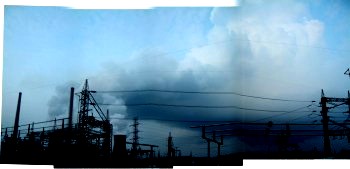
Panoramic photo of cell at the John Amos plant - click to enlarge
RELATED ARTICLE: Artificially-Initiated Thunderstorms
The AEP John Amos power plant is located on the Kanawha River near the border
of Kanawha and Putnam counties in west-central West Virginia, about 20 miles
west of Charleston. The plant sports three large cooling towers and two
tall exhaust stacks. Warm moisture in the form of steam constantly billows
from the cooling towers, on some days producing unusually tall cumulus-like
plumes. The base of the plumes is usually at the same altitude as
surrounding clouds.
In a mildly unstable airmass in place over most of the USA on the afternoon of July 18, 2002, the power plant
started initiating and sustaining a small convective cell at around 6:30PM
EDT. The cell persisted until after 10:30PM. A special weather statement was issued by the National Weather Service indicating that radar estimates showed the cell had dropped as much as 3 inches of rain in the Cross Lanes area, and that localized flooding was possible.
The following is a radar image showing the cell over the plant, located just
northwest of Charleston and right on the border of Putnam county. The cell remains stationary over the plant throughout the loop.

Click for loop
I drove underneath the base of the cell near Cross Lanes, WV about 5 miles
east of the power plant, where to my amazement intracloud lightning
discharges were occurring. Unfortunately due to the daylight and the
lightning being deep in the clouds, I could not photograph it. A shaft of
heavy rain with a distinct boundary (you could almost walk up to it and stay
dry) stayed in the same location along Rocky Fork Road for nearly 45 minutes.
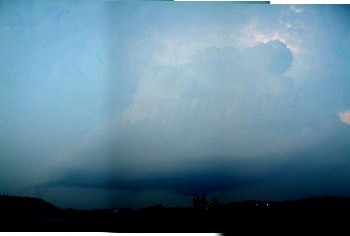
View of the cell from 4 miles to the south. The John Amos plant is behind the mountain on the left, indicated by the plume of steam from the cooling towers. - click to enlarge
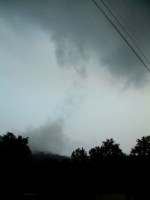 Thunderstorms and rain showers in West Virginia often produce graceful fog formations that rise from the forested mountains. The fog column at right is rising from a hill beside Rocky Fork Road underneath the John Amos storm (click photo to enlarge). Thunderstorms and rain showers in West Virginia often produce graceful fog formations that rise from the forested mountains. The fog column at right is rising from a hill beside Rocky Fork Road underneath the John Amos storm (click photo to enlarge).
I have been watching this phenomenon for years, and always wondered if it could initiate a storm - the answer came on that afternoon.
It is important to note that the plant itself did not generate the storm. The atmosphere that afternoon was very unstable, primed for thunderstorm development. The combination of heat and moisture from the plant acted as a 'trigger' for convection to begin, possibly by eroding a capping inversion in the immediate vicinity above the plant. The storm was then sustained by the convective energy from the unstable atmosphere, while the plant continued to act as a 'trigger factor' for the next few hours.
RELATED ARTICLE: Artificially-Initiated Thunderstorms
More Power Plant Cloud Formations
The John Amos Plant, and other similar plants around the world, produce different types of exhaust-induced clouds. The shape and size of these clouds change with varying weather conditions and seasons, and are interesting to observe. A second page on this site offers a compilation of 2 years of observations of the John Amos cloud plumes (below).

From Scott Depot, 6Mi West

From Scott Depot, 6Mi West

From Scott Depot, 6Mi West

Heavy Rain on Rocky Fork Road
< Back Home | Artificially-Initiated Thunderstorms | More Power Plant Cloud Formations
GO: Home | Storm Chase Logs | Photography | Extreme Weather Library | Stock Footage | Blog
Featured Weather Library Article:
|