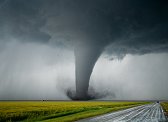
All indications are that the 2013 El Reno tornado's EF-5 rating will be restored at some point in the near future. The official EF-3 rating of the tornado by the National Weather Service is a result of a temporary, internal bureaucratic constraint to exclude the radar data and limit the rating criteria to observed damage only.
Consider these quotes from two of the most prominent and respected figures in severe storms meteorology and tornado science:
"There's no question from our radar data - and Josh Wurman was nearby, we both saw windspeeds of well over 100 meters per second (223mph) - there's no question this was an EF-5 tornado" - Dr. Howie Bluestein (source)
"I don't agree with the (National) Weather Service, it was not an EF3 tornado, I don't care what they think, they're flat wrong! - Dr. Chuck Doswell (source)
Two independent mobile doppler radar units measured - not estimated - EF5 windspeeds in the tornado. The Norman, Oklahoma National Weather Service office that assigned the initial rating has more experience and qualifications than anyone in the world when it comes to forecasting, warning and rating violent tornadoes. They are not amateurs! They know what they are doing. Furthermore, the top tornado scientists in the world strongly disagreed with the downgrade directive from NWS leadership.
One of the biggest myths being repeated everywhere about the Fujita scale (and its successor, the EF Scale) is that "it's just a damage scale". This is not true. The F & EF scales are tornado intensity (windspeed) scales that use damage to infer/estimate tornado windspeeds (intensity). The end goal is to rate tornadoes by how strong they are, much in the same way hurricanes are rated.
The original, official EF scale recommendation itself advocated the eventual adoption of other types of data/evidence (such as mobile radar) in rating tornadoes:
The technology of portable Doppler radar should also be a part of the EF Scale process, either as a direct measurement, when available, or as a means of validating the wind speeds estimated by the experts. - A Recommendation for an ENHANCED FUJITA SCALE
(EF-Scale) ( Link to original document (PDF))
Not only that, the upcoming revisions to the EF scale are expected to include mobile radar measurements in ratings. The idea that the F/EF scale is meant to strictly limit itself to damage and dogmatically exclude all other evidence or data is simply false. That may be the position of NWS leadership (at this time), but not the scientific community nor even the person (Dr. Ted Fujita) who conceived of the scale itself.
Since the scientific community is in strong agreement that mobile radar measurements should be included in tornado ratings (when available), it is highly likely that the El Reno tornado's EF-5 rating will be restored when the NWS policy is ultimately revised to reflect the scientific consensus. Therefore, I will consider this tornado an EF-5 with regards to its intensity, and will continue to refer to it as such on this web site. In the event that the scientific consensus on mobile radar ratings of tornadoes changes, I will revise my web pages and Youtube videos accordingly, but I have not yet received any indication that this has occurred.
The original intent of the F and EF scales was to estimate tornado intensity by surveying the damage one produces. Tornadoes in rural areas are typically under-rated by a damage-only application of the EF scale, as a rural tornado usually does not strike the necessary objects needed to satisfy damage rating requirements. This problem is offset when a tornado is sampled by mobile radar, in which case the damage survey is not needed to determine the tornado's true peak intensity. Currently, the NWS must exclude mobile radar observations as rating criteria, but only due to outdated policy. When this policy is ultimately revised, the official ratings of tornadoes sampled by mobile radar (including the May 31 El Reno tornado) will be updated.
For further reading on this issue:
- An Update to the Enhanced Fujita Scale - March 2022 - by Tim Marshall, HAAG Engineering
- Chuck Doswell: The EF-Scale Ratings Brouhaha
- StormTrack thread on the El Reno rating: with relevant information by RaxPol radar operator Jeff Snyder.
- Recommendation for an ENHANCED FUJITA SCALE (EF-Scale) Submitted to The National Weather Service by Texas Tech University.
|